KIIP for International Students in Busan: What It Is, Levels, Fees and Visa Benefits
Also in: Tiếng Việt · Bahasa Indonesia · Bahasa Melayu · اردو · বাংলা
KIIP is the Korean government's program for foreign residents who want to learn Korean and understand Korean society. For students, it's a low-cost way to keep studying Korean, and your KIIP level can earn you points for the visas you may need after graduation. Here is what KIIP is, how the levels work, what it costs and why it matters for students in Busan.
What is KIIP?
KIIP stands for the Korea Immigration and Integration Program (사회통합프로그램, sahoe tonghap peurogeuraem). It's a program designed to help foreign residents learn, step by step, the basics they need for life in Korea: the Korean language, plus the economy, society and law of Korea. Its goal is to help you settle in easily and feel at home in your local community.
To do this, KIIP starts with a basic knowledge level test (기본소양 사전평가) and gives you a completion level. Together, they measure your Korean ability and how well you understand Korean society, so you start in the right class.
KIIP is run by the Ministry of Justice and taught at approved centers, including universities and community centers in Busan. The program has two parts:
- Levels 0 to 4: Korean language. Everyday Korean, from the alphabet to intermediate level.
- Level 5: Understanding Korean society. Korean culture, history, economy, law and how society works, taught in Korean.
The official website: Socinet
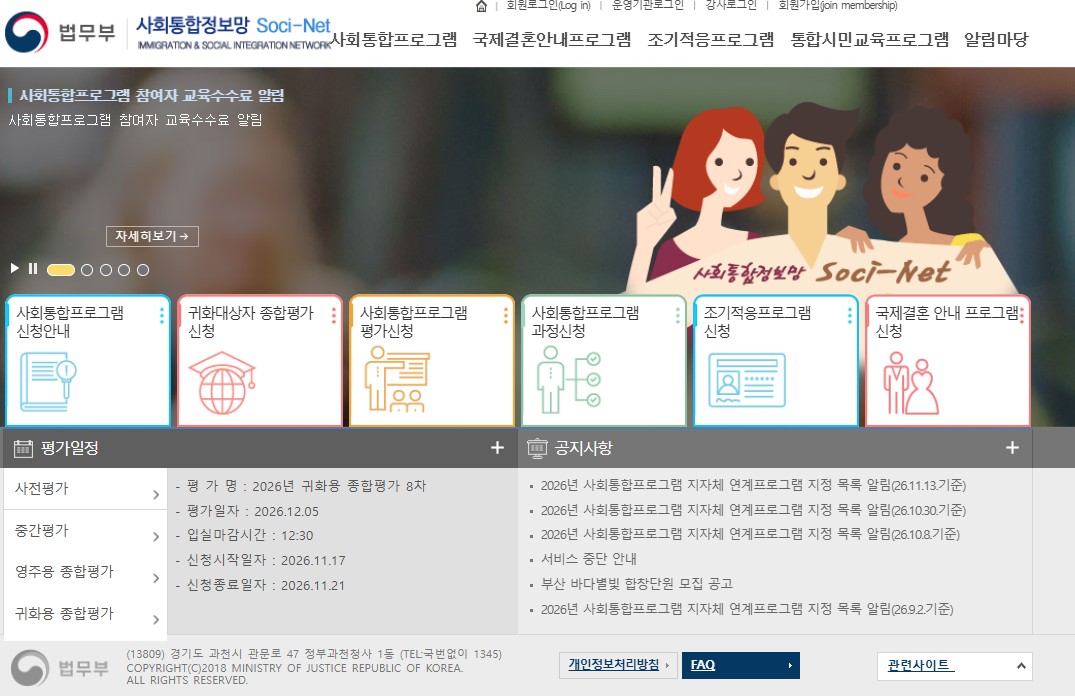
Everything about KIIP happens on Socinet (사회통합정보망). The site is in Korean, but the main buttons are easy to find:
- 사회통합프로그램 신청안내: how to apply for KIIP.
- 사회통합프로그램 평가신청: book a test, such as the level test.
- 사회통합프로그램 과정신청: sign up for a class.
- 평가일정 (test schedule) and 공지사항 (notices): dates and news.
Step-by-step: how to apply for KIIP →
Can international students join?
- Yes, if you have an ARC. KIIP is for registered foreign residents, so D-2 (degree) and D-4 (language course) students can join once they have their Alien Registration Card. Short-term visitors can't.
- Get your ARC first. You sign up with your Alien Registration Number. See how to get your ARC in Busan.
- Check your schedule. Most levels are 100 hours of class, usually on weekday evenings or weekends. Make sure it fits around your university classes and any part-time work.
Why it's worth it for students
- Points for your next visa: KIIP results can add points when you apply for the job-seeking visa (D-10) or the points-based residence visa (F-2-7) after graduation. For F-2-7, the points go up with each level you complete, from Level 2 to Level 5.
- Long-term plans: completing Level 5 is one way to meet the Korean-language requirement for permanent residency (F-5) and naturalization.
- Cheap Korean classes: 100 hours of class with a qualified teacher for KRW 100,000.
- Real-life Korean: you learn the Korean you need for hospitals, offices, banks and work, plus how Korean society works.
KIIP or TOPIK? They do different jobs. Your university and scholarships usually ask for TOPIK. KIIP helps most if you plan to stay and work in Korea. The good news: a TOPIK score can place you straight into a higher KIIP level (see below).
The levels at a glance
| Level | Course | Hours | Fee |
|---|---|---|---|
| 0 | Basic Korean (alphabet) | 15 | Free |
| 1 | Beginner 1 | 100 | KRW 100,000 |
| 2 | Beginner 2 | 100 | KRW 100,000 |
| 3 | Intermediate 1 | 100 | KRW 100,000 |
| 4 | Intermediate 2 | 100 | KRW 100,000 |
| 5 (basic) | Understanding Korean society | 70 | KRW 70,000 |
| 5 (advanced) | Understanding Korean society, for naturalization | 30 | KRW 30,000 |
- Half price: if you attend every class in a level, or your teacher recommends you, the next level costs 50% less.
- Tests have their own fee: the level test, the interim test (after Level 4) and the final test (after Level 5) cost about KRW 38,000 each. The small tests at the end of Levels 1 to 3 are free.
- Textbooks: each level has its own official textbook, which you buy separately.
Fees and rules can change. Before you sign up, check the latest on the official site: Socinet (KIIP)
Classes: what to expect
- Mostly in person. Levels 0 to 2 are taught face to face. Online classes are only allowed in special cases, mostly from Level 3.
- Attendance matters. You need enough attendance to finish a level, and full attendance gets you the 50% discount on the next one.
- Class times vary by center: weekday daytime, weekday evening and weekend classes. Most centers run two or three terms a year.
Tips from Busan students
- Ask your university first. Your international office can tell you whether your campus or a center nearby runs KIIP classes. Study Busan Hub can also help.
- Don't overload your semester. 100 hours is a lot on top of your degree. Many students start KIIP during the vacation or in a lighter semester.
- Keep your records. Save your level results and completion certificates. You'll need them for visa applications later.
- Want to start for free? Build your basics first with free Korean apps and websites.
See also: TOPIK explained · your visa options after graduation
Comments & student tips
Did something change, or did you do it differently? Share it here and help the next student. Every comment is checked by our team before it appears.
Loading comments…