GKS Scholarship 2027 (Global Korea Scholarship): Benefits, Eligibility, Results and Busan Universities
Also in: Tiếng Việt · Bahasa Indonesia · Bahasa Melayu · اردو · বাংলা
The Global Korea Scholarship (GKS) pays your flight, your full tuition, a year of Korean classes and about KRW 1.2 million a month to live on. Here is what the 2027 undergraduate scholarship (GKS-U) offers, who can apply, the real deadlines, and which universities in Busan take GKS scholars.
Official 2027 GKS-U notice: download the Application Guidelines (English and Korean PDF), the application forms and the University Information files for every university and department.
Open the official GKS notice →What GKS gives you (2027)
| Benefit | Amount |
|---|---|
| Airfare | One economy ticket to Korea (actual cost) |
| Tuition | Full tuition: NIIED pays up to KRW 5 million per semester, and the university covers the rest and the admission fee |
| Korean language program | One year, paid directly to the university (KRW 5.2 million a year) |
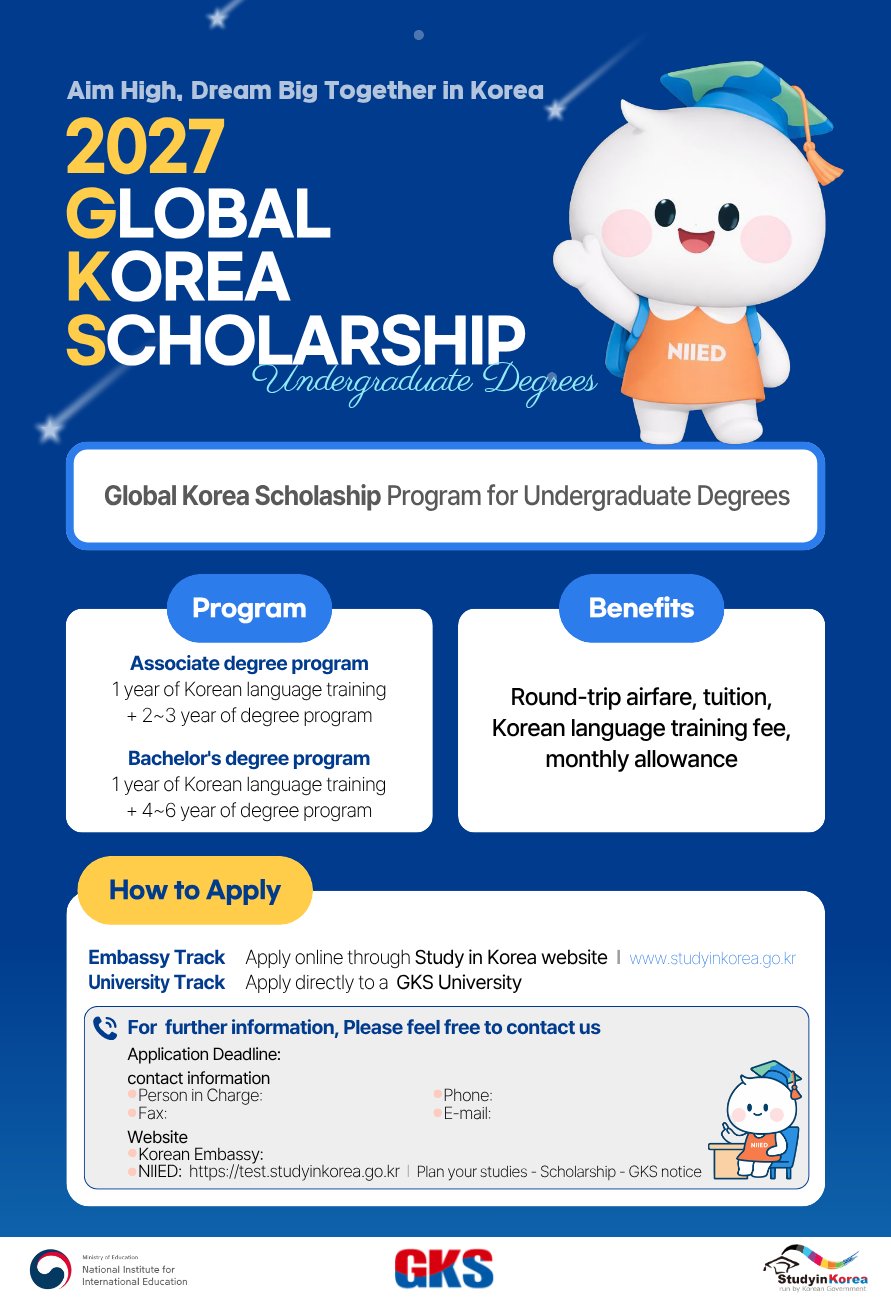
| Monthly allowance | KRW 13.56 million a year during Korean classes (about 1.13 million a month), KRW 14.4 million a year during your degree (about 1.2 million a month) |
Rules, fees and limits can change. Before you act, check the latest on the official site: Study in Korea (NIIED)
The monthly allowance is all-inclusive: it covers living costs, housing, health insurance, the TOPIK fee, the settlement allowance and the completion grant. Plan your budget with that in mind. See our cost of living guide.
How long the scholarship lasts
- Bachelor's degree: 5 to 7 years (1 year of Korean + 4 to 6 years of degree study)
- Associate degree: 3 to 4 years (1 year of Korean + 2 to 3 years of degree study)
Already have TOPIK level 5 or 6? You skip the Korean year and start your degree in March. Every other scholar must reach at least TOPIK level 3 during the Korean year to continue. Some departments ask for level 4. You take your Korean classes at the same university where you will study your degree.
Two ways to apply
| Track | How it works | 2027 timing | Places |
|---|---|---|---|
| Embassy Track | Apply online on Study in Korea. The Korean embassy in your country does the first selection. You choose up to 3 universities (at least one Type B) or, for R-GKS, up to 2 regional universities. | 15–30 September 2026 (closed) | 156 |
| University Track | Apply directly to one university and one department. Two programs: UIC (science and engineering with industry links, open to all countries) and Associate degree. | September–November 2026, set by each university | 130 |
You can only apply to one track, one program and (on the University Track) one university at a time. Applying to more than one gets your application thrown out. The only exception: if you fail the Embassy Track first round, you may then apply through the University Track.
Who can apply
- Citizenship: you and both parents must not hold Korean citizenship (no dual citizens). The Embassy Track is open to 74 countries. UIC is open to all countries.
- Age: under 25, born on or after 1 March 2002.
- Education: high school graduate (or graduating by 31 December 2026). Associate degree holders may apply for a bachelor's. People who already have a bachelor's cannot apply.
- Grades: one of these: 80% or above, top 20% of your class, or a CGPA of at least 2.64/4.0, 2.80/4.3, 2.91/4.5 or 3.23/5.0.
- Not eligible: graduates of a Korean high school or Korean associate degree, and anyone who already received a Korean government scholarship for a degree.
2027 Embassy Track places for our readers' countries
| Country | General | R-GKS (regional) | Total |
|---|---|---|---|
| Bangladesh | 2 | 1 | 3 |
| Pakistan | 2 | 1 | 3 |
| Indonesia | 2 | 2 | 4 |
| Malaysia | 1 | 1 | 2 |
| Vietnam | 1 | 1 | 2 |
| India | 2 | 2 | 4 |
| Nepal | 1 | 1 | 2 |
| Uzbekistan | 1 | 1 | 3* |
* Includes 1 place for overseas Koreans and adoptees.
Embassy places are very few, so the University Track is often the more realistic route. It has 130 places shared across all countries.
GKS universities in and around Busan
Busan has more GKS universities than any city outside Seoul. R-GKS applicants choose only from regional (Type B) universities like these.
| Track | Universities |
|---|---|
| Embassy Track (Type B) | Busan University of Foreign Studies, Dong-A University, Kyungsung University, Pukyong National University, Pusan National University, Silla University, Tongmyong University · nearby: Inje University (Gimhae), University of Ulsan |
| Embassy Track (Type A) | Nearby: UNIST (Ulsan) |
| University Track (UIC, bachelor's) | Dong-A University, Inje University (Gimhae) |
| University Track (UIC, associate) | Dong-Eui Institute of Technology |
| University Track (Associate degree) | Busan Institute of Science and Technology, Dong-Eui Institute of Technology, Kyungnam College of Information & Technology |
Each university lists its open departments and language requirements in the "University Information" files on the GKS notice page. The international office phone numbers and emails are in Appendix C and D of the guidelines.
How you are selected
- Round 1: the embassy or university checks your documents (Embassy Track results by 16 October; University Track in November).
- Round 2: NIIED reviews all recommended candidates (Embassy Track in November; University Track in December).
- Round 3 (Embassy Track only): your chosen universities decide, by 23 December.
- Final results: expected 7 January 2027 on the Study in Korea website. Nobody will email you each result, so check the GKS notices yourself.
Extra points that can help
- TOPIK: level 3 adds 3% of the total score, level 4 adds 4%, level 5 or above adds 5%. Language scores are also part of the main evaluation. TOPIK explained →
- Science and engineering majors: +5%.
- Descendants of Korean War veterans: +10%.
- Applicants from low-income backgrounds and overseas Koreans are also given preference.
Documents you will need
- Application form, personal statement and study plan (GKS forms 1–3)
- Recommendation letter (form 4), applicant agreement, medical self-assessment and privacy consent (forms 5–7)
- Proof of citizenship for you and your parents, and proof of your family relationship
- High school (and associate degree) graduation certificate and transcript, with apostille or consular confirmation
- TOPIK or English test score (if you have one), up to 5 award or activity certificates (optional), passport
Not sure how legalization works? See our D-2 visa checklist, which explains apostille and consular confirmation.
Tips to improve your chances
- Make your study plan specific. Say why this major, why Korea, and what you will do after graduating.
- Choose universities carefully. If many people pick the same university, you can pass NIIED's round and still fail at every university you chose.
- You cannot change your major after selection. Pick a field you really want.
- Get extra apostilled copies of your graduation certificate before you fly. You will need them for your university, your visa and immigration.
- Missed 2027? Start preparing now for 2028: take TOPIK, keep your grades up, and watch the GKS notices from August.
Graduate students: GKS-G
There is a separate GKS program for master's and PhD students, with about 1,600 places. Its guidelines usually come out around February. Watch the GKS notices on Study in Korea.
Not GKS? Other ways to save on tuition in Busan
Many Busan universities cut tuition for international students based on TOPIK level or English scores, and some give large discounts for high TOPIK levels. Every school has its own rules, so compare scholarships, dorm and meal costs together.
Official 2027 GKS-U notice: download the Application Guidelines (English and Korean PDF), the application forms and the University Information files for every university and department.
Open the official GKS notice →GKS questions students ask
What is GKS?
The Global Korea Scholarship is the Korean government's scholarship for international students, run by NIIED. It used to be called KGSP (Korean Government Scholarship Program).
What grades do I need for GKS?
One of these: 80% or above, the top 20% of your class, or a CGPA of at least 2.64/4.0, 2.80/4.3, 2.91/4.5 or 3.23/5.0.
Do I need TOPIK to apply?
No. TOPIK is not required, but level 3 or higher adds 3–5% to your score. Scholars without TOPIK 5 study Korean for a year first.
How much does GKS pay each month?
About KRW 1.2 million a month during your degree, plus airfare and full tuition.
Which universities in Busan accept GKS scholars?
Pusan National, Pukyong National, Dong-A, Kyungsung, Silla, Tongmyong and Busan University of Foreign Studies, among others. See GKS universities in and around Busan.
Comments & student tips
Did something change, or did you do it differently? Share it here and help the next student. Every comment is checked by our team before it appears.
Loading comments…